Cast: Aaron Douglas, Edward James Olmos, Mary McDonnell
Synopsis: Battlestar Galactica ran for four seasons on the SyFy network and is considered by many the best science-fiction television program yet created. Focusing on a fleet of human survivors from a mass genocide, the program explored all manner of personal and political issues. Among those was labor – in this episode from the third season one of the main characters restarts a union by becoming the leader of a strike on a mining ship. “Dirty Hands” explores several facets of labor, most interestingly how unions navigate their relationship to the government and their role in promoting social mobility.
Synopsis: Fired for trying to organise a union, contract workers at GM Daewoo go to extreme measures, holding a sit-in strike from the perch of a CCTV tower. With undertones of Michael Moore’s Roger and Me, the film exposes the brutal treatment irregular workers face in their struggle
Synopsis: A film about a worker’s strike at a textile plant, written and enacted by the actual striking workers. This film was a collaborative and collective effort. Videotapes of upcoming scenes were discussed by the workers, and camera angles as well as dramatic refinements were agreed on before any film was exposed. Given that the film presents the worker’s point of view and is a largely amateur effort, reviewers found it surprisingly effective as a dramatic piece. One interesting feature of the film, and of the strike itself, is that it was organized and led by women. While there had been male union leaders, they were bypassed or ousted for their lack of leadership, understanding, or negotiating skills. A small textile factory, like many others. At the beginning, women in a clothing or weaving workshop. Some of them are young, some of them are old and others are middle-aged; they come here, every day, to produce in the heat, forcing the pace, enduring their tiredness. As well as can be expected, each of them lives her life : 8 hours in the factory, a new workday begins at the way out : shopping, housework, children, husbands. New financial or affective concerns. Anyway, so many women’s life. But in the workshop, things are progressively changing. They less and less can stand to be oppressed : they sabotage machines, they stop working… The boss reacts quickly and roughly: agitators are fired. To obtain two womens reinstatement, they are all going to unite. Unite to find every kind of action which could make them attempt their goal. From union speech to the final sequestration they are going to manage a terrible fight.
135m; U.S. Director: John Sayles Cast: Chris Cooper, James Earl Jones, Mary McDonnell, David Strathairn
Synopsis: John Sayles, one of the leading independent directors in the world, came to WV in 1983 to film one of the most famous confrontations between laborer and owners in the town of Matewan, Mingo County, WV, 1920. It took him four years to finally finish the film, directing “Brother from another Planet” during that time period. Coal miners, struggling to form a union, are up against company operators and Baldwin-Felts agents. Black and Italian miners, brought in by the company to break the strike, are caught between the two forces. Union activist and ex-Wobbly Joe Kenehan (Chris Cooper), sent to help organize the union, determines to bring the local, black, and Italian groups together. Drawn from an actual incident; the characters of Sheriff Sid Hatfield (David Strathairn), Mayor Cabell Testerman (Josh Mostel), C. E. Lively (Bob Gunton) , and Few Clothes Johnson were based on real people. James Earl Jones plays Few Clothes Johnson, a black coal miner who joins the union to stop massive abuses. The execution of Sheriff Hatfield on the steps of the McDowell County Courthouse steps by Baldwin-Felts agents led to the 1921 Battle of Blair Mountain, the largest armed labor conflict in American history. Music by WV native Hazel Dickens. Nominated for an Oscar by Haskell Wexler for best cinematography. Filmed in Thurmond and the New River Gorge, WV.
Trailer
Key Clip
In this scene, Chris Cooper’s organizer character gives an impassioned speech about the meaning of being in a union, with an explicit attack on racism and other forces that would divide workers.
Synopsis: Sally Fields won an Oscar for Best Actress for her portrayal of a Southern textile worker in the 1970s. Faced with problems and challenges both personal and at work, Norma Rae proves receptive to the message of a union organizer seeking to start a drive at her plant. The film is based on the real story of Crystal Lee Sutton and the ACTWU’s drive to organize JP Stevens’ plants in the South in the 1970s.
Cast: Warren Beatty, Diane Keaton, Edward Hermann, Jerzy Kosinski, Maureen Stapelton, Gene Hackman
Synopsis: Reds is the epic biography of early 20th century U.S. communist author and activist Jack Reed and his stormy off-again, on-again love affair with free-thinker Louise Bryant. The film covers some of Reed’s time in the United States (including relationships with the IWW and the Socialist Party) and their time together in Russia during the Bolshevik revolution which led Reed to write the book Ten Days that Shook the World. The film also covers attempts to build a communist party in the U.S., the post-World War I “Red Scare” and the early years of the U.S.S.R. Maureen Stapelton won an Oscar for her portrayal of Emma Goldman and Beatty won for Best Director. Interspersed throughout the film are interviews with many of the people who knew Reed and Bryant. Long but highly recommended.
Click here to read Jon Garlock’s introduction to Reds at the Rochester (NY) Labor Film Series.
Cast: Juan Chacón, Rosaura Revueltas and Will Geer
Synopsis: Salt of the Earth is based on a 1950 strike by zinc miners in Silver City, New Mexico. Against a backdrop of social injustice, a riveting family drama is played out by the characters of Ramon and Esperanza Quintero, a Mexican-American miner and his wife. In the course of the strike, Ramon and Esperanza find their roles reversed: an injunction against the male strikers moves the women to take over the picket line, leaving the men to domestic duties. The women evolve from men’s subordinates into their allies and equals.
NYT: Movies don’t get much more Labor Day-appropriate than a film backed by the International Union of Mine, Mill and Smelter Workers. But “Salt of the Earth” was perceived as a dangerous object in 1954, when the principal members of its creative team — the director Herbert J. Biberman, the producer Paul Jarrico and the screenwriter Michael Wilson, working independently of Hollywood — were subject to the blacklist. (The Congress of Industrial Organizations had separately expelled the union from its ranks.) This chronicle of a New Mexico miners’ strike, dramatized from real events and now a favorite of film programmers, looks ahead of its time in its foregrounding of Mexican-American characters; its emphasis on racial and especially gender equality; and its powerful depiction of unity against strikebreaking tactics. BEN KENIGSBERG
Cast: Grigori Aleksandrov, Maksim Shtraukh and Mikhail Gomorov
Synopsis: In Russia’s factory region during Czarist rule, there’s restlessness and strike planning among workers; management brings in spies and external agents. When a worker hangs himself after being falsely accused of thievery, the workers strike. At first, there’s excitement in workers’ households and in public places as they develop their demands communally. Then, as the strike drags on and management rejects demands, hunger mounts, as does domestic and civic distress. Provocateurs recruited from the lumpen and in league with the police and the fire department bring problems to the workers; the spies do their dirty work; and, the military arrives to liquidate strikers.
In a decade, tiny Brooks, Alberta has been transformed from a socially conservative, primarily Caucasian town to one of the most diverse places in Canada. Hijabs have become commonplace, downtown bars feature calypso and residents speak 90 different languages. Immigrants and refugees have flocked here to work at Lakeside Packers – one of the world’s largest slaughterhouses. Centering on the 24 days of the first-ever strike at Lakeside, this film is a nuanced portrait of people working together and adapting to change. They are people like Peter Jany Khwai, who escaped war in Sudan, wears an African shirt and a cowboy hat, and affirms his Canadian identity as well as his determination to fight for his rights. Or Edil Hassan, a devout Muslim born in Somalia, who counts her hours of organizing and picketing among her proudest moments. As 24 Days in Brooks shows, people from widely different backgrounds can work together for respect, dignity, and change – even though getting there is not easy.
24 Days in Brooks was produced as part of the Reel Diversity Competition for emerging filmmakers of colour. Reel Diversity is a National Film Board of Canada initiative in partnership with CBC Newsworld. The DVD includes the original English version of the film and the English version with French subtitles.
Contact Info: http://www.onf-nfb.gc.ca/eng/collection/film/?id=56986
 135m; U.S.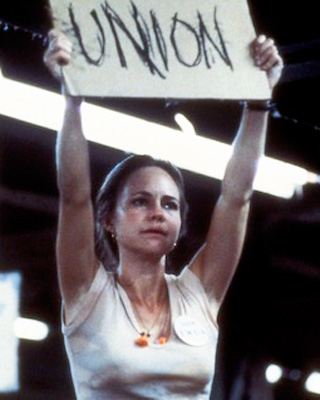


 THE LABOR FILM DATABASE