Synopsis (WV Div. of Culture): Using archival footage, the story of this 1960’s populist uprising in West Virginia is told in cinema verité style. Interviews with several miners with black lung are mixed with comments by many West Virginia experts on coal mine safety to tell a compelling story of their success fighting their own union, the State Legislature, and the U.S. Congress. Their victory was the much-heralded Federal Coal Mine Health and Safety Act of 1969. Congressman Ken Hechler, primary author of the bill, is shown addressing miners in Kanawha County. Doctors, labor leaders, and government officials of the day are also interviewed.
Contact: Print Source Alexandra Sun The Film Library 3345 Wilshire Boulevard, Suite 700 Los Angeles, CA 90010 Phone: (310) 603-8748 Fax: (310) 362-8890 Email: thefilmlibrary@aol.com
135m; U.S. Director: John Sayles Cast: Chris Cooper, James Earl Jones, Mary McDonnell, David Strathairn
Synopsis: John Sayles, one of the leading independent directors in the world, came to WV in 1983 to film one of the most famous confrontations between laborer and owners in the town of Matewan, Mingo County, WV, 1920. It took him four years to finally finish the film, directing “Brother from another Planet” during that time period. Coal miners, struggling to form a union, are up against company operators and Baldwin-Felts agents. Black and Italian miners, brought in by the company to break the strike, are caught between the two forces. Union activist and ex-Wobbly Joe Kenehan (Chris Cooper), sent to help organize the union, determines to bring the local, black, and Italian groups together. Drawn from an actual incident; the characters of Sheriff Sid Hatfield (David Strathairn), Mayor Cabell Testerman (Josh Mostel), C. E. Lively (Bob Gunton) , and Few Clothes Johnson were based on real people. James Earl Jones plays Few Clothes Johnson, a black coal miner who joins the union to stop massive abuses. The execution of Sheriff Hatfield on the steps of the McDowell County Courthouse steps by Baldwin-Felts agents led to the 1921 Battle of Blair Mountain, the largest armed labor conflict in American history. Music by WV native Hazel Dickens. Nominated for an Oscar by Haskell Wexler for best cinematography. Filmed in Thurmond and the New River Gorge, WV.
Trailer
Key Clip
In this scene, Chris Cooper’s organizer character gives an impassioned speech about the meaning of being in a union, with an explicit attack on racism and other forces that would divide workers.
Cast: Charlize Theron, Jeremy Renner and Frances McDormand
Synopsis (IMDB): A fictionalized account of the first major successful sexual harassment case in the United States — Jenson vs. Eveleth Mines, where a woman who endured a range of abuse while working as a miner filed and won the landmark 1984 lawsuit.
(NYT) Set in and around the iron mines of Northern Minnesota between 1989 and 1991, Niki Caro’s muscular and absorbing drama addresses workplace sexual harassment at its most primitive and bludgeoning. A dowdy Charlize Theron is Josey Aimes, a poor single mother and newly hired miner. Hated by the men and unprotected by the union, Josey and her peers are relentlessly groped and sadistically bullied — behavior that reflects a community riddled with regressive misogyny.
Driven by righteous anger and inspired by a spearheading real-life lawsuit, the movie rises above its fight-the-power formula with a fabulous cast — including Sissy Spacek, Frances McDormand and Woody Harrelson — and a potent sense of place. In Chris Menges’s gorgeously smoky shots of blasted earth and gnashing machinery, spraying explosions and blackened pits, we see an oppressively alien landscape that’s hostile to man and woman alike. JEANNETTE CATSOULIS
Cast: Juan Chacón, Rosaura Revueltas and Will Geer
Synopsis: Salt of the Earth is based on a 1950 strike by zinc miners in Silver City, New Mexico. Against a backdrop of social injustice, a riveting family drama is played out by the characters of Ramon and Esperanza Quintero, a Mexican-American miner and his wife. In the course of the strike, Ramon and Esperanza find their roles reversed: an injunction against the male strikers moves the women to take over the picket line, leaving the men to domestic duties. The women evolve from men’s subordinates into their allies and equals.
NYT: Movies don’t get much more Labor Day-appropriate than a film backed by the International Union of Mine, Mill and Smelter Workers. But “Salt of the Earth” was perceived as a dangerous object in 1954, when the principal members of its creative team — the director Herbert J. Biberman, the producer Paul Jarrico and the screenwriter Michael Wilson, working independently of Hollywood — were subject to the blacklist. (The Congress of Industrial Organizations had separately expelled the union from its ranks.) This chronicle of a New Mexico miners’ strike, dramatized from real events and now a favorite of film programmers, looks ahead of its time in its foregrounding of Mexican-American characters; its emphasis on racial and especially gender equality; and its powerful depiction of unity against strikebreaking tactics. BEN KENIGSBERG
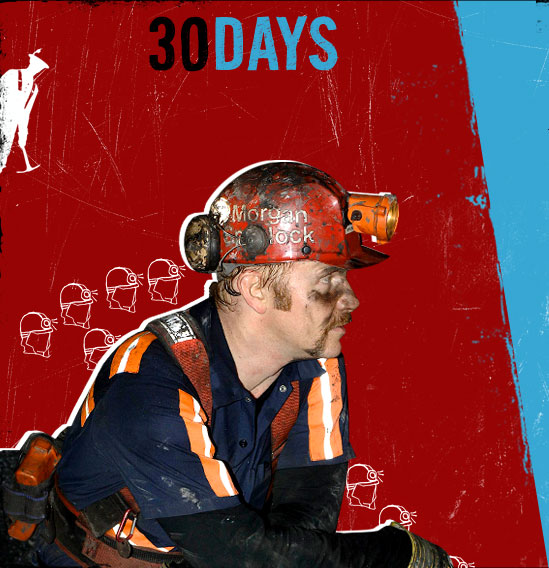
55M; U.S. Director: Morgan Spurlock Cast: Morgan Spurlock
30 Days TV series (FX) creator Morgan Spurlock returns to his home state of West Virginia, to work as a rookie apprentice coalminer known as a “redhat” for 30 days. He also takes a little time to socialize with the miners and their families, and briefly explores the problems of mountaintop removal mining and the destruction of both the environment and the coal miners’ health.
 135m; U.S.
 126m; U.S.
 THE LABOR FILM DATABASE