2018 Oscar Selection, Slovenia
Since leaving Bosnia in the 1970s, Alija (Leon Lučev) has been working as a miner in Slovenia’s Zasavje coal region. One of many migrant workers employed in a failing industry, Alija is afraid to refuse when he is tasked with opening a long-sealed mineshaft to declare it empty. When he opens the abandoned shaft, however, Alija uncovers some terrible secrets. Refusing to bow to his employers’ demands to stay quiet, Alija sets out to expose the truth. Based on a true story, Slovenian director Hanna Slak’s (BLIND SPOT) powerful third feature reveals a dark chapter in Slovenia’s history with honesty and compassion. Winner, Best Director and Best Actor, 2017 Festival of Slovenian Film. DIR/SCR Hanna Slak; PROD Miha Knific, Siniša Juričić. Slovenia/Croatia, 2017, color, 98 min. In Slovenian with English subtitles. NOT RATED
Run Time: 98 Minutes
Genre: Thriller
Category Archives: Working Class
Death in Sarajevo

Smrt u Sarajevu
DANIS TANOVIC
Bosnia & Herzegovina, 2016
85 minutes, Color
Official website
Winner of the Jury Grand Prix and the International Film Critics Award at last year’s Berlin International Film Festival, Death in Sarajevo is a timely drama from acclaimed Bosnian filmmaker Danis Tanovic (FFDC 2015’s Tigers, the 2001 Foreign Language Oscar®-winning No Man’s Land). At Sarajevo’s Hotel Europe, preparations are under way to host the European Union’s centenary commemorating the assassination of Franz Ferdinand by Gavrilo Princip that triggered World War I, a French actor is in the Presidential Suite rehearsing the Bernard-Henri Levy play from which the hotel got its name, and a TV crew is filming local scholars discussing regional history. Manager Omer is dealing with a cash flow problem and a looming strike by workers while his assistant, Lamija, tries to keep things organized in the face of growing discord. What could possibly go wrong in the course of this highly charged history lesson?—Eddie Cockrell
In Bosnian with English subtitles
Xmas without China (2013)
Directed By: Alicia Dwyerl
Runtime: 70 min
Stars: – – –
Synopsis: Exploring the intersection of commercialism and immigration in American culture, the documentary filmmakers follow their friend and fellow filmmaker Tom Xia on an intimate, humorous journey to get to know his neighbors
The Measure of a Man (2015)
Directed by: Stéphane Brizé
Running Time: 93 min
Starring: N/A
Synopsis: An unemployed factory worker is trying to make ends meet in working-class France.
Is there a word for that slow exhale — a kind of sad groan — you release when witnessing an emotionally excruciating moment? Whatever that sound is called, you’ll make it often during “The Measure of a Man,” a devastating look at a middle-age worker who, after losing his job, struggles to retain his dignity. Vincent Lindon, in a performance that won him the best actor award at Cannes in 2015, is heartbreaking as he interviews for positions, attends retraining sessions and eventually finds work. Yet his new job soon puts him under a quiet, brutal pressure. The most agonizing scenes in the film (directed by Stéphane Brizé; its original title, in French, is “La Loi du Marché,” or “Market Law”) don’t feature bombastic speeches or didactic critiques of capitalism. Instead, we watch small disappointments bruise a good man’s soul. KEN JAWOROWSKI (NYT)
Living Wage Now
32.51 minutes
People in the West hear of the conditions endured by garment workers making clothes in Asian factories, but they rarely see them. A short documentary by the Asia Floor Wage Alliance (AFWA), a group of trade unions and labor rights activists, offers a glimpse of people at work in India, Cambodia, and Indonesia. It includes footage from factories, which aren’t necessarily tiny, claustrophobic rooms with decrepit walls and little light. The most startling conditions are where the workers live. Some live in homes that are little more than a single, bare room with no toilet or running water.
Read more
See the whole film here: https://youtu.be/PxFwA-jw3X4
Trailer: https://youtu.be/zsR87lFmE6Y
In Dubious Battle (2016)
Based off the John Steinbeck novel: an activist gets caught up in the labor movement for farm workers in California during the 1930s.
Director: James Franco
Industria Argentina (2011) (Argentine Industry)
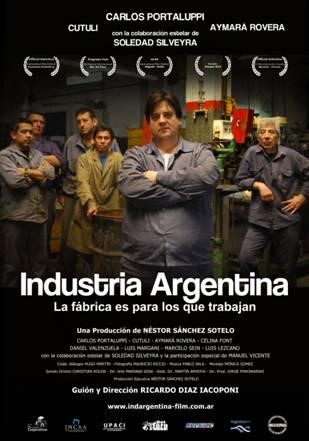
Directed by: Ricardo Díaz Iacoponi
Country: Argentina.
Running Time: 96 minutes.
Starring: Aymará Rovera, Carlos Portaluppi, Cutuli.
http://www.indargentina-film.com.ar/indexar.html
Trailer: http://indargentina-film.com.ar/trailer.html
At Arlumar, a spare parts factory, workers resist to lose their only means of earning their living. Juan, as well as many other employees, has not collected his salaries for months. His pregnant wife and his debts make him foresee a very dark future ahead. Little by little, taking control of their desperation, Juan and his coworkers begin to organize themselves to keep running the company that has been abandoned by its owners. In that way, they assume the rebuilding of a company that has no employers, which proves to be a heavy burden to carry.
Evelyn Williams
Directed by Anne Lewis, USA, Appalshop,1995 (28 minutes)
https://store.appalshop.org/shop/appalshop-films/evelyn-williams/
Evelyn Williams is a portrait of a woman who is many things: a coal miner’s daughter and wife; a domestic worker and mother of nine; a college student in her 50s and community organizer; an Appalachian African American. Above all, she is a woman whose awareness of class and race oppression has led her to a lifetime of activism. Now in her 80s, she is battling to save her land in eastern Kentucky from destruction by a large oil and gas firm.
With humor, eloquence, and at times anger, Evelyn tells her story. Her family came to eastern Kentucky in 1922 when she was six years old. She remembers the Klan burning a cross on the mountain and describes the sense of powerlessness that followed a lynching for which the murderers were never arrested. She married a coal miner and later moved to West Virginia where her daughters were able to attend college.While her husband worked in the mines and helped organize the union, she cleaned the homes of coal company bosses. When the mines mechanized and laid off workers, the family moved to Brooklyn, N.Y. where Evelyn studied at the New School for Social Research and became active in efforts to improve her community. Her commitment to fight for justice and equality was deepened when her son was killed in Vietnam and the U.S. military misinformed and mistreated the family. Following retirement in the early 70′s, Evelyn and her husband returned to a piece of family land in Kentucky. Most recently, she has been a leader of a grassroots effort by Kentuckians for the Commonwealth to end oil and gas company use of the broadform deed to drill on surface owners’ land without their permission. In explaining her determination to preserve her land, she recalls her grandfather, an ex-slave, who said, “Take care of the land. Take care of the land. As long as you have land, you have a belonging.” The program portrays a fascinating and dynamic personality whose keen sense of communal and family history influences her determination. Through her story, Evelyn makes important connections between civil rights, women’s rights, and environmental concerns.
Buzzard (2014)
97 min | Comedy, Drama | 6 March 2015 (USA)
Director/writer: Joel Potrykus
Stars: Joshua Burge, Joel Potrykus, Teri Ann Nelson
Marty is a caustic, small-time con artist drifting from one scam to the next. When his latest ruse goes awry, mounting paranoia forces him from his lousy small town temp job to the desolate streets of Detroit with nothing more than a pocket full of bogus checks, a dangerously altered Nintendo® Power Glove, and a bad temper. Albert Camus meets Freddy Krueger in BUZZARD, a hellish and hilarious riff on the struggles of the American working class.
NYTimes: Review: In ‘Buzzard,’ an Angry, Unkempt Antihero
An unsparing portrait of an office temp and scam artist near the bottom of the economic food chain.
NYTimes: Joel Potrykus’s Film ‘Buzzard’ Is Inspired by Dead-End Jobs
The writer and director’s deadpan comedies have followed a man-child on the skids.
Tales (2014) “Ghesse-ha” (original title)
88 min | 30 July 2015 (Argentina)
A series of seven vignettes about different people dealing with their every day problems in modern day Iran, that are loosely related to each other.
Director: Rakhshan Bani-Etemad
Writers: Rakhshan Bani-Etemad, Farid Mostafavi
Stars: Habib Rezaei, Mohammad Reza Forutan, Mehraveh Sharifinia
 THE LABOR FILM DATABASE